
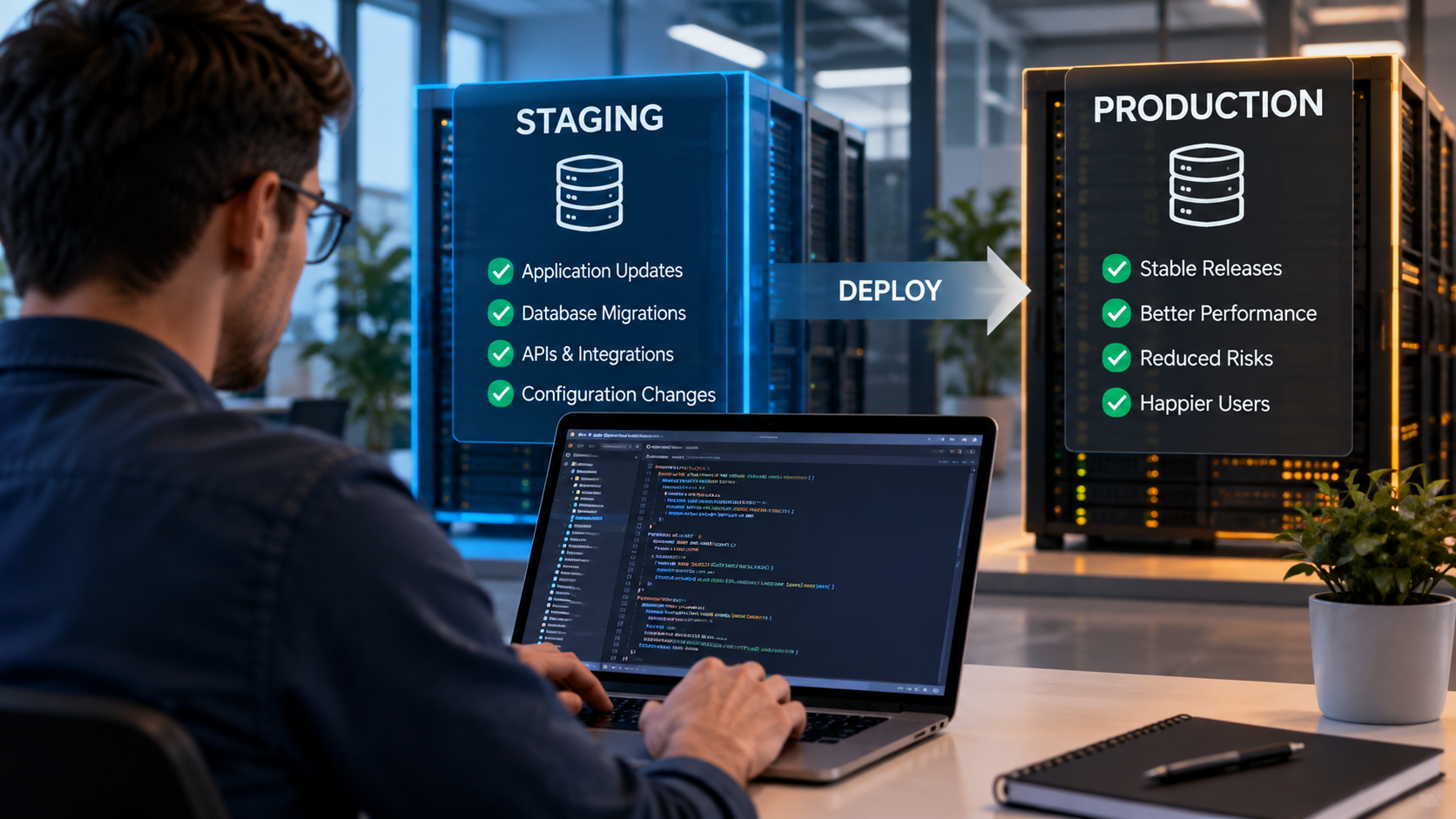
As applications grow, maintaining stability becomes increasingly challenging. New features, software updates, database changes, and third-party integrations introduce risks that can affect performance, security, and user experience. Even a seemingly minor configuration adjustment can cause unexpected problems when deployed directly to a live application.
For development teams, the challenge is not simply delivering updates quickly. It is ensuring that those updates work reliably without disrupting existing functionality. This is where a staging environment becomes an essential part of the software development lifecycle.
A staging environment provides a controlled space where teams can test application changes under conditions that closely resemble production. By identifying potential issues before deployment, organizations can reduce downtime, improve release quality, and maintain a more predictable development process.
What Is a Staging Environment?
A staging environment is a separate deployment of an application designed to simulate its live production environment. It allows developers, quality assurance engineers, and operations teams to evaluate updates before making them available to end users.
Unlike a local development environment, where individual developers build and test features on their own machines, staging brings application components together in a shared infrastructure. This makes it possible to evaluate how the complete system behaves when multiple services, databases, APIs, and integrations interact.
For example, an application might function correctly during local testing but encounter problems when deployed behind a load balancer or connected to a managed database. A staging environment helps reveal these differences before they affect customers.
Organizations can establish staging infrastructure using a dedicated cloud server, allowing them to separate testing workloads from production while configuring the computing resources, operating systems, and networking components required by their applications.
Why Staging Becomes More Important as Applications Grow
During the early stages of development, applications often have relatively simple architectures. A small team may manage a limited number of features, dependencies, and integrations. Under these circumstances, local testing can sometimes appear sufficient.
However, growing applications typically become more complex. They may serve thousands of users, process sensitive information, communicate with external platforms, and depend on several interconnected services.
As complexity increases, so does the possibility that a change in one component will affect another.
A staging environment helps manage this risk by introducing a validation step between development and production. Instead of releasing changes immediately after local testing, teams can examine their behavior in a more realistic environment.
This approach becomes particularly valuable for applications that require frequent updates, support business-critical operations, or maintain high availability expectations.
Testing Application Updates Before Release
One of the primary purposes of staging is to validate application updates before deployment.
New features may introduce unexpected interactions with existing functionality. Similarly, updates to frameworks, libraries, or application dependencies can create compatibility issues that are difficult to identify through isolated testing.
In staging, teams can perform functional testing, regression testing, and user acceptance testing against a complete deployment of the application.
For example, an e-commerce platform introducing a new checkout feature should verify more than the appearance of the updated interface. The development team must also confirm that shopping carts, payment processing, inventory updates, and order notifications continue to function correctly.
Staging provides an opportunity to evaluate these workflows together rather than assuming that successful individual tests guarantee a successful production release.
It also allows stakeholders outside the development team to review changes and provide approval before deployment.
Validating Database Migrations
Database changes are among the most sensitive operations in application maintenance.
As applications evolve, teams frequently modify database schemas, introduce new tables, update indexes, or migrate existing records. These operations can affect application compatibility, query performance, and data integrity.
Deploying an untested database migration directly to production can result in failed queries, application errors, extended maintenance periods, or data loss.
A staging environment enables teams to rehearse database migrations before executing them on live systems.
Developers can verify whether migration scripts complete successfully, measure their execution time, and confirm that the application remains compatible with the updated schema.
For larger databases, staging should ideally contain a representative volume and structure of data. A migration that completes in seconds against a small development database may require considerably more time when processing millions of records.
Teams should also test backup restoration and recovery procedures where appropriate. Sensitive production information should be anonymized or replaced with synthetic data before being introduced into staging.
Testing APIs and Third-Party Integrations
Modern applications rarely operate independently. They commonly rely on external APIs and services for payment processing, authentication, messaging, analytics, logistics, and other essential functions.
These integrations introduce dependencies that may behave differently outside a developer’s local environment.
A staging environment allows teams to test API requests, authentication mechanisms, response handling, error conditions, and communication between internal services.
Consider a business application that integrates with a third-party payment gateway. Before releasing an update, developers need to confirm that payment requests are formatted correctly, responses are processed accurately, and failed transactions are handled without creating inconsistent records.
Where available, staging should connect to sandbox versions of external services rather than live production endpoints. This helps prevent accidental financial transactions, customer notifications, or modifications to real accounts.
Testing should also account for API timeouts, rate limits, expired credentials, and unexpected responses. These scenarios can expose weaknesses that remain invisible during routine local development.
Checking Configuration and Infrastructure Changes
Not every application failure originates from source code. Configuration errors can be equally disruptive.
Changes to environment variables, access permissions, network settings, web server configurations, caching systems, and security policies may affect how an application operates.
For instance, an incorrect environment variable could prevent an application from connecting to its database. A misconfigured reverse proxy might interrupt API communication, while an improperly configured caching layer could cause users to receive outdated information.
Staging allows teams to validate these changes before applying them to production.
Infrastructure changes, including operating system updates, runtime upgrades, container configurations, and deployment scripts, can also be tested in staging.
This is especially important for teams adopting automated deployment pipelines. By including staging as a deployment stage, organizations can verify that their build and release processes function as intended before production rollout.
Staging vs. Local Development: Understanding the Difference
Although both environments support testing, local development and staging serve different purposes.
A local development environment is primarily designed for writing code, debugging features, and conducting rapid tests. Developers often use simplified databases, mock services, and configurations optimized for convenience.
Staging, by contrast, is intended to evaluate the application as a complete deployed system.
The distinction becomes significant when applications depend on components that are difficult to reproduce locally, such as distributed services, production-like networking, external authentication providers, or specific infrastructure configurations.
Local development helps answer whether a feature works during implementation. Staging helps determine whether that feature is ready to operate within the broader application.
Both environments are necessary because they address different categories of risk.
How Closely Should Staging Match Production?
A staging environment delivers the greatest value when it accurately represents the production setup.
Ideally, staging should use the same application versions, operating systems, runtime dependencies, database engines, and deployment methods as production.
Network architecture, security settings, and service configurations should also be sufficiently similar to reveal deployment-related problems.
However, staging does not always need identical computing capacity.
For example, a production application may operate across several high-capacity servers, while staging uses fewer resources to control infrastructure costs. This arrangement can be suitable for functional testing, provided that the differences are understood.
When teams need to validate performance, scalability, or infrastructure behavior under heavy workloads, staging or a separate performance-testing environment should reproduce production capacity and traffic characteristics as closely as practical.
The objective is not necessarily to duplicate every production resource. It is to ensure that differences between the environments do not conceal the problems staging is intended to detect.
Best Practices for Maintaining an Effective Staging Environment
Creating a staging environment is only the beginning. Maintaining its reliability requires consistent operational practices.
Teams should keep staging aligned with production software versions and deployment configurations. Updates should follow a repeatable process, ideally using the same automation employed for production releases.
Access should be restricted to authorized personnel, and staging should never be treated as an unsecured environment simply because it is not publicly accessible.
Application logs, monitoring systems, and error reporting should also be available to help identify problems during testing.
Test data should be managed carefully, particularly when applications process personal, financial, or confidential information. Using anonymized or synthetic data reduces unnecessary exposure.
Finally, teams should establish clear release criteria. A successful deployment to staging should be followed by appropriate automated tests, manual validation where needed, and approval before production deployment.
These practices help turn staging into a dependable quality-control mechanism rather than an occasional testing server.
Staging as Part of a Reliable Deployment Strategy
For growing applications, deployment reliability is closely connected to business continuity.
Unexpected outages can interrupt transactions, reduce employee productivity, damage customer confidence, and create additional operational costs. As applications become more important to daily business activities, the consequences of deployment failures become more significant.
A staging environment helps organizations approach releases systematically.
Instead of relying entirely on assumptions or limited local testing, development teams gain an opportunity to validate changes in a controlled setting. This supports more confident deployments, faster identification of compatibility problems, and improved collaboration between development, testing, and operations teams.
Staging does not eliminate every production risk. Differences in traffic, data, infrastructure capacity, and external dependencies can still produce unexpected behavior after release. However, when combined with automated testing, monitoring, backups, and rollback procedures, it provides an important additional layer of protection.
Conclusion
As software applications expand, the risks associated with direct production deployments become increasingly difficult to manage.
A dedicated staging environment provides the foundation for testing application updates, validating database migrations, verifying APIs and integrations, and examining configuration changes before they reach users.
By maintaining a production-like testing environment and integrating it into the release process, organizations can identify problems earlier, reduce avoidable disruptions, and deliver updates with greater confidence.
For any application expected to grow in users, functionality, or operational importance, staging should be considered a core component of reliable software delivery rather than an optional addition.