
7
An EU-supported initiative under Culture for All, in partnership <a href="https://gulfeyenews.com/jaecoo-partners-with-the-hunger-games-to-drive-hybrid-mobility-and-customer-community-in-uae/”>with the Ministry of Culture, bringing children together through creativity and shared experiences.
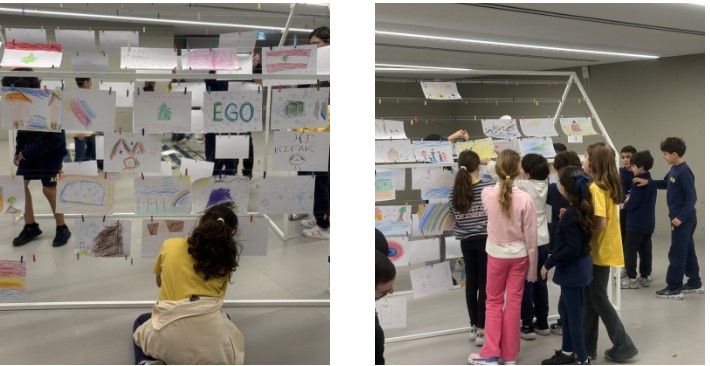
Approximately 500 students from public and private schools across Lebanon are coming together to create a collective artistic installation at the Nuhad Es-Said Pavilion for Culture, at the National Museum of Beirut. Supported by the European Union under Culture for All, implemented in partnership with the Ministry of Culture and in collaboration with the Ministry of Education and Higher Education (MEHE), the initiative invites children to explore the meaning of home, belonging and solidarity through art.
Conceived and led by Lebanese artist Abed Al Kadiri, the collective artistic installation “This House Belongs to Everyone” brings together hundreds of children’s drawings, gradually transforming a house-shaped structure into a collective artwork. Through workshops taking place at the Nuhad Es-Said Pavilion until 30 November 2026, students from different backgrounds are invited to share their perspectives and contribute their own visions of home.
Through collective drawing sessions across Lebanon, the wider artistic initiative, launched by Abed Al Kadiri in 2020 in response to violence, destruction and displacement, has engaged more than 1,000 displaced children, generating 180 metres of drawings subsequently transformed into 36 large-scale Leporello books.
These artists’ books are presented in the parallel exhibition “Today I Would Like to Be a Tree” at the Nuhad Es-Said Pavilion for Culture, curated by Abed Al Kadiri and featuring contributions from 22 contemporary artists from Lebanon and beyond. The exhibition provides a broader artistic context for the EU-supported participatory installation.
Hundreds of Drawings, One Collective Home
During the ongoing workshops, participating students encounter drawings created by displaced children in schools and shelters across Lebanon. These drawings offer personal reflections on home, displacement, and the experiences of children affected by difficult circumstances.
Inspired by these images, students create their own drawings, expressing their vision of a dream home and responding to the emotions and stories conveyed through the original artwork.
Each drawing is added to a metal structure outlining the shape of a house. Over the course of the workshops, the structure will gradually transform into a collective artwork composed of hundreds of individual contributions forming “This House Belongs to Everyone”.
Reflecting on the artistic concept and the collaborative process, Abed Al Kadiri explains:
“Art is not only a beautiful painting hanging on a wall. It is also what happens beyond that wall, in the spaces we create, the people we bring together, and the lives we touch. I believe art has the capacity to become an act of solidarity, a space for dialogue, and a means of collective repair.”
Beyond artistic expression, the workshops encourage students to engage with the experiences of other children, fostering empathy, dialogue, and a sense of shared belonging.
During the workshops, participating children, aged seven, expressed what having a home means to them:
- “Having a home makes me feel safe.”
- “We cannot survive without a home.”
- “When you are away from home, you feel scared in another place.”
The gradual unveiling of “This House Belongs to Everyone”, is now accessible to the public until December 1st, 2026, at the Nuhad Es-Said Pavilion for Culture, at the National Museum of Beirut, inviting visitors to explore the children’s contributions and reflect on the different meanings of home and belonging.
With the participation of students from both public and private schools, and in collaboration with the Ministry of Education and Higher Education, the initiative highlights the importance of providing young people with opportunities to engage in artistic and cultural experiences.
The initiative carries particular significance in the context of Lebanon’s recent displacement crises, during which many public schools were transformed into temporary shelters for displaced families. As these schools gradually resumed their educational activities, the workshops offer children an opportunity to come together through artistic expression, sharing their experiences and imagining a collective space of belonging.