
Qatar’s Digital Economy Continues to Expand Rapidly
- Data is emerging as an economic asset through processing, analysis and organisation.
- Strengthening the legislative framework for personal data protection is essential.
Doha – For Immediate Release – November 2026
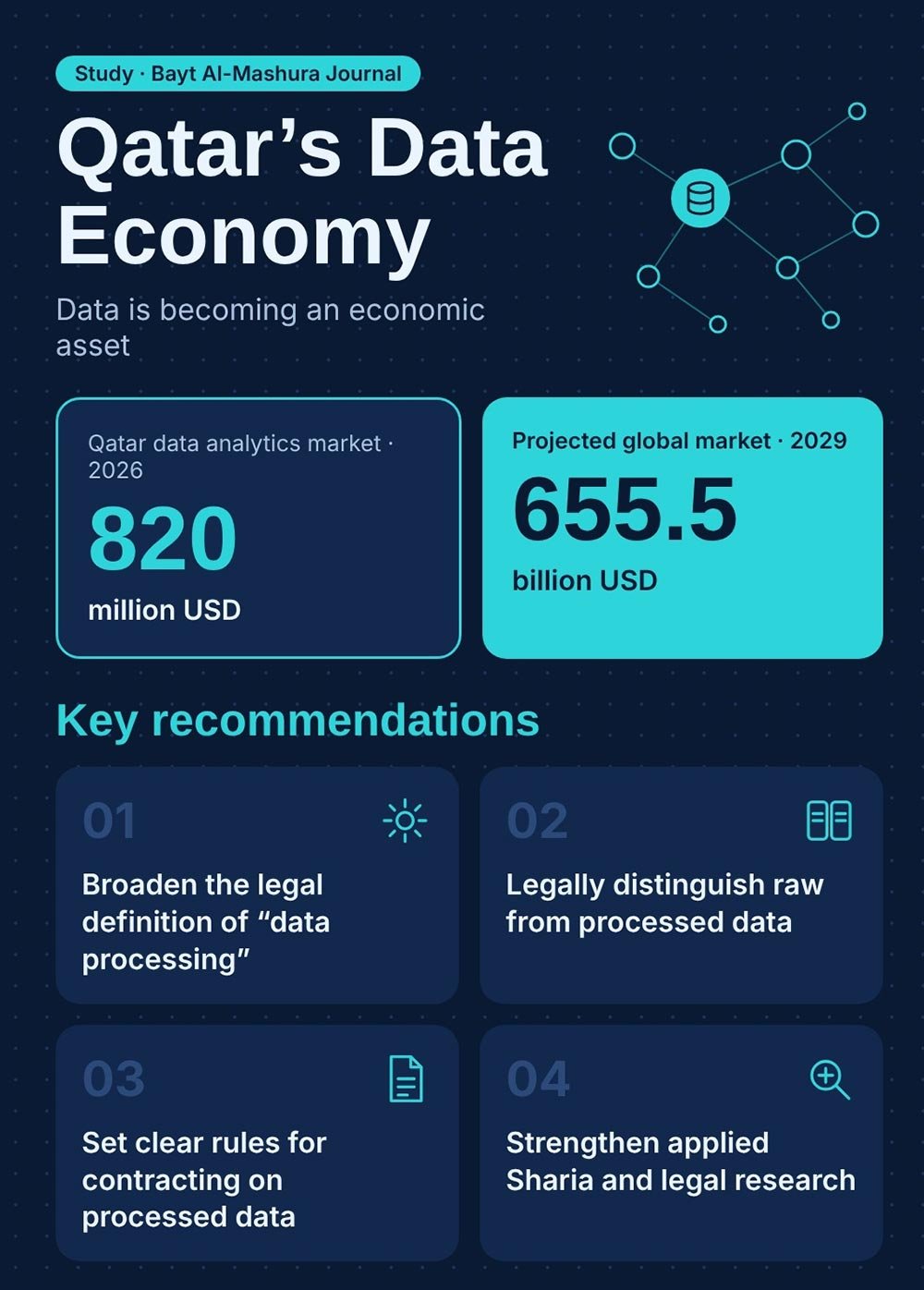
A study by Qatari researcher Nour Dukhail Allah Al-Nabet and Mourad Boudaia, Assistant Professor at Qatar University’s College of Sharia and Islamic Studies, highlights the growing economic value of personal data and the need to develop legal frameworks governing its use and commercial exploitation. The study notes that Qatar’s data analytics market is projected to reach approximately $820 million in 2026, according to figures from TASMU, the digital programme of the Ministry of Communications and Information Technology (MCIT).
Published in Bait Al Mashura Journal, issued by Bait Al-Mashura Finance Consultations and ranked first in the Arab world in the field of Islamic economics and finance, the study examines the financial, jurisprudential and legal dimensions of personal data. It also highlights the continued expansion of the global big data analytics market, which is projected to reach $655.53 billion by 2029.
Entitled “The Jurisprudential and Legal Foundations of the Financial Nature of Personal Data: A Comparative Study with Qatari Law,” the study explores the distinction between raw personal data and data that has undergone processing, analysis and organisation, examining how this distinction affects the legal and financial status of data.
The researchers explain that raw personal data remains closely connected to the individual, particularly with regard to privacy, personal rights and human dignity. However, once data is processed, analysed and organised, it may acquire economic value and become an asset with a financial character that can be licensed or commercially exploited, provided that the rights of the individuals concerned are protected.
The study also examines the different jurisprudential approaches to defining property and financial rights. It notes that the Hanafi school adopts a relatively restrictive approach to the concept of property, while the Maliki, Shafi’i and Hanbali schools take broader approaches that recognise certain rights and benefits as having financial value, subject to specific conditions.
In light of these differences, the researchers favour a broader understanding of financial rights that takes account of contemporary developments and the growing economic importance of data. Such an approach, they argue, can help address the legal questions arising from the commercial use of processed personal data without compromising the rights of individuals.
From a legal perspective, the study examines Qatar’s Civil Code No. 22 of 2004, particularly Article 56, in relation to the legal concept of property and the scope of rights that may be subject to financial dealings. The researchers consider this provision relevant to assessing whether processed data may acquire a legally recognised financial character.
The study also refers to Article 37 of the Constitution of Qatar, which safeguards individual privacy, and Law No. 13 of 2016 on Protecting Personal Data Privacy. The law establishes a framework governing the collection, processing and retention of personal data, while setting out obligations for entities handling such data and protections for individuals.
Despite the existing legislative framework, the study identifies areas that could benefit from further clarification, particularly the distinction between raw personal data and data that has been processed and transformed into an economically valuable asset. It argues that clearer legal provisions would help address questions concerning the use, licensing and commercial exploitation of processed data.
The researchers recommend expanding the definition of data processing under Article 1 of Law No. 13 of 2016, while introducing a clearer distinction between raw and processed data. They also call for more detailed rules governing contracts, licensing arrangements and the commercial use of processed data, alongside safeguards to ensure that the rights and privacy of data subjects remain protected.
The study further recommends expanding applied jurisprudential and legal research into the financial nature of personal data, in order to keep legislation aligned with technological developments and emerging business models.
As Qatar continues to advance its digital transformation and develop its data-driven economy, the study underscores the importance of a balanced legal approach—one that recognises the economic potential of data while maintaining robust safeguards for privacy and individual rights.